
)
23 January 2026
This accessible lecture of Thomas Leblé (CNRS - Paris Cité University, LMS Distinguished Visiting Fellow at ICMU) is devoted to the mathematics of plasma. We invite students, researchers, and everyone who is curious about the topic and familiar with basic mathematical tools.
The "one-component plasma", also called "jellium" or "Coulomb gas", is a toy model of statistical physics. It consists in a random configuration of point particles, each carrying a unit charge, placed in a fixed uniform background of opposite charge, the interactions being given by a repulsive Coulomb potential. Its mathematical study goes back to Dyson in the 1960's. The corresponding probability distribution happens to have a close connection with classical models in random matrix theory, with the Laughlin wavefunction for Quantum Hall Effect, as well as with certain deterministic questions regarding optimal arrangements of points. In dimension two, physicists have predicted that the system forms a perfectly ordered lattice at zero temperature, and later undergoes a "melting" transition. Thomas Leblé will present some mathematical tools that have been recently developed in order to study this "order to disorder" transition.
Image: Simulation of a "two-dimensional one-component plasma" at three different temperatures. By lowering the temperature, the system becomes more ordered. — Thomas Leblé
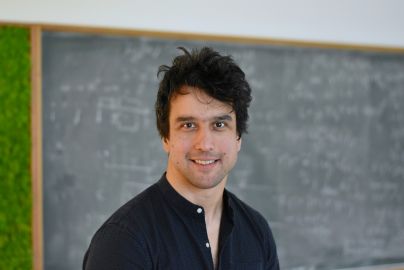
Thomas Leblé is an LMS Distinguished Visiting Fellow at ICMU. He serves as a CNRS research fellow at Paris Cité University and lectures at École Polytechnique. Thomas obtained his PhD at Pierre and Marie Curie University in 2016 and had appointments as a Courant Instructor at New York University and a member of the Institute for Advanced Study in Princeton. His research interests lie at the intersection of probability theory and mathematical physics, specifically focusing on problems in classical statistical physics and long-range interactions.
ICMU Working Space
Kyiv School of Economics
KSE Dragon Capital Building
Mykoly Shpaka St 3, Kyiv